Anatomy
Applied Surgical Anatomy
Applied anatomy taught through the planes, compartments, nerves and vessels that explain surgical access, injury patterns and common operative problems.
Recommended start Inguinal Canal & Inguinal Hernia

Featured lessons
Start with the essentials.
Guide-selected lessons that establish the most useful foundations for this subject.
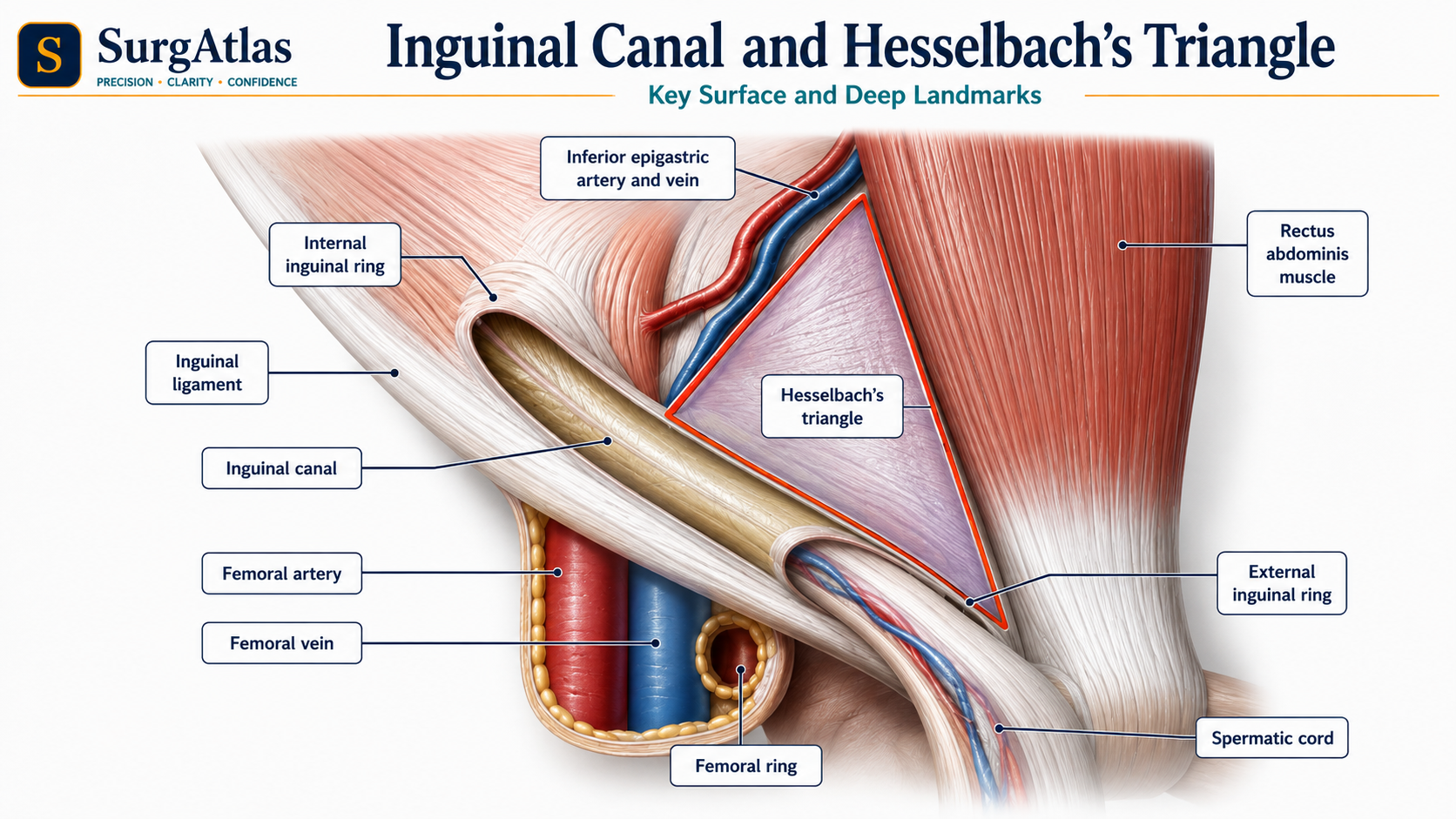
Inguinal Canal & Inguinal Hernia
MRCS-focused inguinal canal anatomy: rings, boundaries, contents, spermatic cord coverings, Hesselbach triangle and the anatomical distinction between direct and indirect inguinal hernias.
Read lessonAnal Canal Anatomy
A high-yield anatomy lesson built around the dentate line and the anatomical transitions that explain pain, lymphatic spread and common anorectal disease.
Read lessonBrachial Plexus
A structured MRCS explanation of the brachial plexus from C5–T1 roots to terminal branches, with key relations and lesion patterns.
Read lessonStudy by topic
Explore every lesson.
Follow the topic groups in order, or go straight to the lesson you need.
Abdominal wall & groin
Build from the abdominal wall into the inguinal and femoral compartments before revising groin hernia disease.
- Read lesson
Abdominal Wall, Rectus Sheath & Surgical Planes
A practical MRCS guide to abdominal-wall layers, surface planes, the arcuate line, inferior epigastric vessels and clinically useful fascial relationships.
11 min readActive recall - Read lesson
Inguinal Canal & Inguinal Hernia
MRCS-focused inguinal canal anatomy: rings, boundaries, contents, spermatic cord coverings, Hesselbach triangle and the anatomical distinction between direct and indirect inguinal hernias.
11 min readActive recall - Read lesson
Femoral Canal & Femoral Ring
Learn the femoral sheath, canal and ring as a compact surgical map, including the vessels and aberrant obturator connection that make repair hazardous.
8 min readActive recall
Pelvis & anorectal anatomy
Use fascial planes, the mesorectum and dentate-line transitions to understand colorectal and anorectal surgery.
- Read lesson
Rectum, Mesorectum & Pelvic Fascia
Connect rectal anatomy to oncological surgery: peritoneal covering, mesorectum, fascial planes and pelvic autonomic nerve preservation.
9 min readActive recall - Read lesson
Anal Canal Anatomy
A high-yield anatomy lesson built around the dentate line and the anatomical transitions that explain pain, lymphatic spread and common anorectal disease.
10 min readActive recall
Upper limb
Move from plexus organisation to regional spaces and the shoulder nerve–muscle relationships tested in MRCS.
- Read lesson
Brachial Plexus
A structured MRCS explanation of the brachial plexus from C5–T1 roots to terminal branches, with key relations and lesion patterns.
10 min readActive recall - Read lesson
Cubital Fossa
A compact applied-anatomy lesson on the cubital fossa, including the bicipital aponeurosis, brachial artery, median nerve and superficial veins.
7 min readActive recall - Read lesson
Shoulder Region: Rotator Cuff & Key Nerves
High-yield shoulder anatomy linking the rotator cuff, quadrangular space, axillary nerve and suprascapular nerve to common examination findings.
9 min readActive recall
Head & neck
Surgical thyroid anatomy centred on laryngeal nerves, vessels and parathyroid preservation.
Related subjects
Keep connecting the curriculum.

Your wider study workspace
Want progress tracking and adaptive study?
Public lessons remain free. A SurgAtlas account adds the wider learning workspace when you are ready.