High-yield map
Key points before the detail
- 01
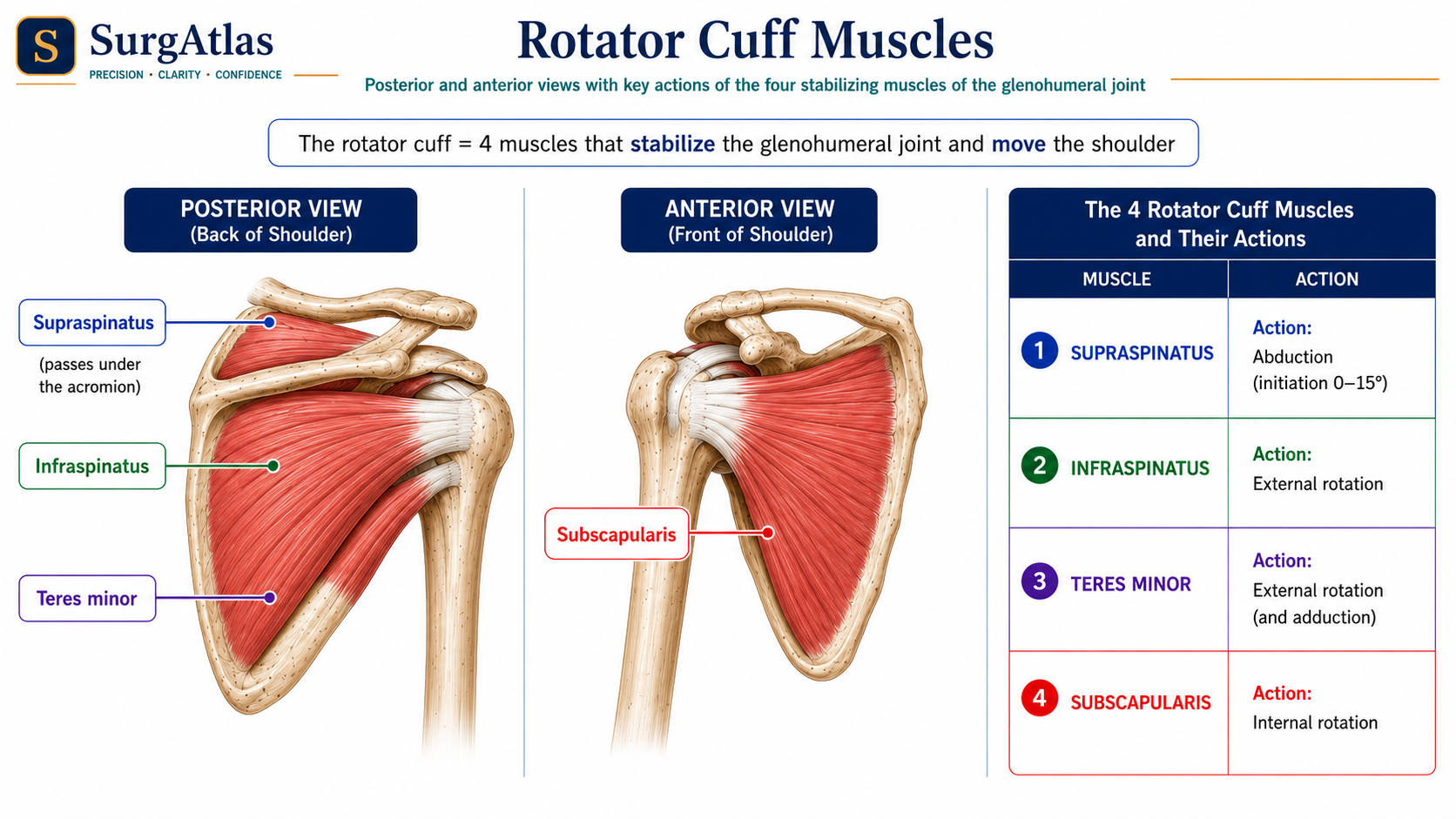
SITS: supraspinatus, infraspinatus, teres minor, subscapularis.
- 02
Axillary nerve and posterior circumflex humeral artery traverse the quadrangular space.
- 03
Suprascapular nerve supplies supraspinatus and infraspinatus; axillary nerve supplies deltoid and teres minor.
- 04
The classic 2:1 scapulohumeral rhythm is a teaching model, not a fixed ratio at every degree of movement.
Rotator cuff
| Muscle | Insertion | Main action | Nerve |
|---|---|---|---|
| Supraspinatus | Superior facet, greater tubercle | Initiates/assists abduction and centres humeral head | Suprascapular C5–6 |
| Infraspinatus | Middle facet, greater tubercle | External rotation | Suprascapular C5–6 |
| Teres minor | Inferior facet, greater tubercle | External rotation | Axillary C5–6 |
| Subscapularis | Lesser tubercle | Internal rotation | Upper/lower subscapular C5–7 |
Quadrangular space
The space transmits the axillary nerve and posterior circumflex humeral artery. This relationship explains the vulnerability of the axillary nerve in surgical-neck fractures and anterior shoulder dislocation.
| Boundary | Structure |
|---|---|
| Superior | Teres minor |
| Inferior | Teres major |
| Medial | Long head of triceps |
| Lateral | Surgical neck of humerus |
Abduction is coordinated
Supraspinatus helps initiate abduction and stabilise the humeral head; deltoid is the major glenohumeral abductor through the mid-range. Trapezius and serratus anterior then upwardly rotate the scapula so the glenoid continues to face the humeral head.
Nerve lesions you should recognise
| Nerve | Pattern |
|---|---|
| Axillary | Weak deltoid abduction, flattened shoulder contour and sensory loss over the regimental-badge area. |
| Suprascapular | Weak initiation of abduction and/or external rotation depending on lesion level; posterior shoulder pain may occur. |
| Long thoracic | Serratus anterior weakness with medial scapular winging and impaired overhead elevation. |
Active recall
Close the notes and answer these
Try each question from memory before revealing the answer. These public prompts are a small preview of the integrated retrieval system inside SurgAtlas.
01What traverses the quadrangular space?
The axillary nerve and posterior circumflex humeral artery.
02Which rotator-cuff muscles are supplied by the suprascapular nerve?
Supraspinatus and infraspinatus.
03Which muscles produce scapular upward rotation for overhead abduction?
Trapezius and serratus anterior act together.
Sources & editorial basis
References & editorial basis
- SurgAtlas production chapter — Anatomy — Upper Limb I. Primary source for this public lesson. The teaching has been condensed from the corresponding production chapter without changing the underlying anatomical relationships.
- Gray’s Anatomy for Students. Reference for stable shoulder and rotator-cuff anatomy.
This lesson is derived from the corresponding SurgAtlas production teaching material. Where the source makes current management or guideline claims, the public lesson uses the cited contemporary guidance. It is written for education and examination preparation, not as patient-specific clinical advice.
Editorial details
Medical Doctor (MD) · MRCS Part A · Physician · Surgical Educator
SurgAtlas is an educational resource. For patient care, verify current national guidance, local antimicrobial and transfusion policies, specialty pathways and individual patient factors.
Continue in SurgAtlas
Turn reading into retrieval.
Use the full learning workspace for chapter progress, integrated questions, review scheduling and exam-focused study tools. Free accounts do not include recurring AI usage.