High-yield map
Key points before the detail
- 01
Berry’s ligament fixes the gland to the upper trachea/cricoid region and lies close to the recurrent laryngeal nerve.
- 02
The right recurrent laryngeal nerve loops under the subclavian artery; the left loops under the aortic arch near the ligamentum arteriosum.
- 03
Superior-pole vessel control is performed close to the thyroid capsule to reduce risk to the external branch of the superior laryngeal nerve.
- 04
The inferior thyroid artery has a variable relationship to the recurrent laryngeal nerve and contributes importantly to parathyroid perfusion.
Position, capsules and fixation
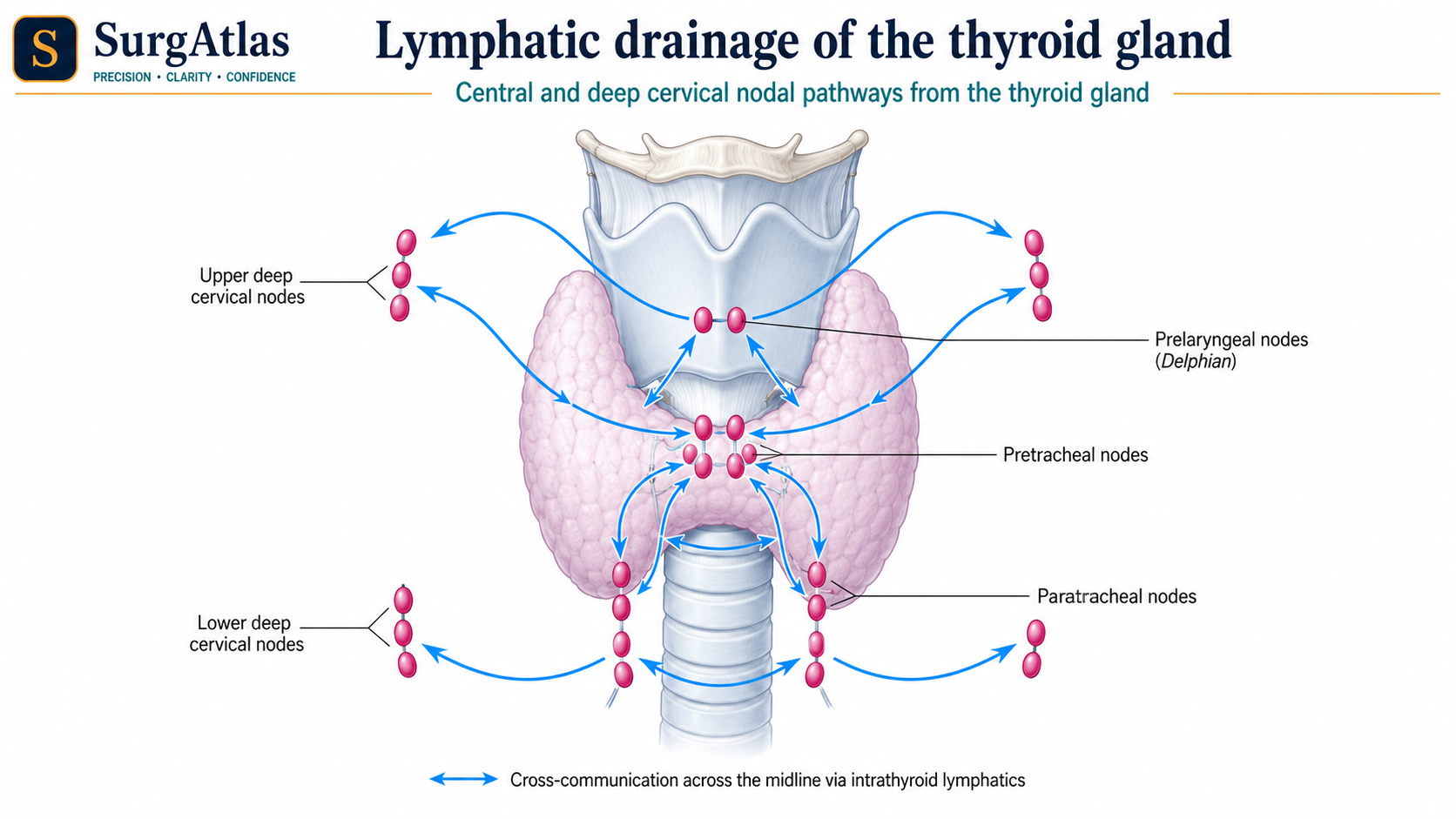
The thyroid consists of two lateral lobes connected by an isthmus, with a variable pyramidal lobe. A true fibrous capsule closely invests the gland; a fascial false capsule derives from pretracheal fascia. Posteromedially, Berry’s ligament fixes the gland to the cricoid and upper trachea, explaining movement on swallowing and the intimate nerve relationship during mobilisation.
Arterial supply
| Vessel | Origin / relationship | Surgical point |
|---|---|---|
| Superior thyroid artery | Usually first anterior branch of external carotid | Branches approach the superior pole near the external laryngeal nerve. |
| Inferior thyroid artery | Thyrocervical trunk | Variable relation to recurrent laryngeal nerve; important supply to parathyroids. |
| Thyroidea ima | Variable, often from brachiocephalic/aortic region | May ascend anterior to the trachea and is relevant to low midline access. |
Recurrent laryngeal nerve
The right recurrent laryngeal nerve loops around the right subclavian artery; the left loops under the aortic arch close to the ligamentum arteriosum. Both ascend towards the larynx, commonly in or near the tracheoesophageal groove, with variable branching and variable relationship to the inferior thyroid artery.
- Motor to all intrinsic laryngeal muscles except cricothyroid.
- Sensory to laryngeal mucosa below the vocal folds.
- Posterior cricoarytenoid is the only abductor of the vocal folds, so bilateral motor injury can threaten the airway.
External branch of the superior laryngeal nerve
The external laryngeal nerve descends towards cricothyroid and can run close to superior thyroid vessels. It supplies cricothyroid, which tenses and lengthens the vocal folds for pitch control. Injury may cause subtle voice fatigue or loss of high pitch even when vocal-fold movement appears broadly preserved.
Parathyroid relationship
Superior and inferior parathyroids lie on or near the posterior thyroid region, but their exact position is variable. Their blood supply commonly depends substantially on branches of the inferior thyroid artery. Safe thyroid surgery therefore requires preservation not only of the glands but also of their vascular pedicles when possible.
Active recall
Close the notes and answer these
Try each question from memory before revealing the answer. These public prompts are a small preview of the integrated retrieval system inside SurgAtlas.
01Why is Berry’s ligament important?
It fixes the posteromedial thyroid to the laryngotracheal framework and brings thyroid dissection close to the recurrent laryngeal nerve.
02Which intrinsic laryngeal muscle is not supplied by the recurrent laryngeal nerve?
Cricothyroid, supplied by the external branch of the superior laryngeal nerve.
03What is the only vocal-fold abductor?
Posterior cricoarytenoid.
Sources & editorial basis
References & editorial basis
- SurgAtlas production chapter — Anatomy — Head & Neck. Primary source for this public lesson. The teaching has been condensed from the corresponding production chapter without changing the underlying anatomical relationships.
- Gray’s Anatomy for Students. Reference for stable thyroid, laryngeal-nerve and parathyroid relationships.
This lesson is derived from the corresponding SurgAtlas production teaching material. Where the source makes current management or guideline claims, the public lesson uses the cited contemporary guidance. It is written for education and examination preparation, not as patient-specific clinical advice.
Editorial details
Medical Doctor (MD) · MRCS Part A · Physician · Surgical Educator
SurgAtlas is an educational resource. For patient care, verify current national guidance, local antimicrobial and transfusion policies, specialty pathways and individual patient factors.
Continue in SurgAtlas
Turn reading into retrieval.
Use the full learning workspace for chapter progress, integrated questions, review scheduling and exam-focused study tools. Free accounts do not include recurring AI usage.