High-yield map
Key points before the detail
- 01
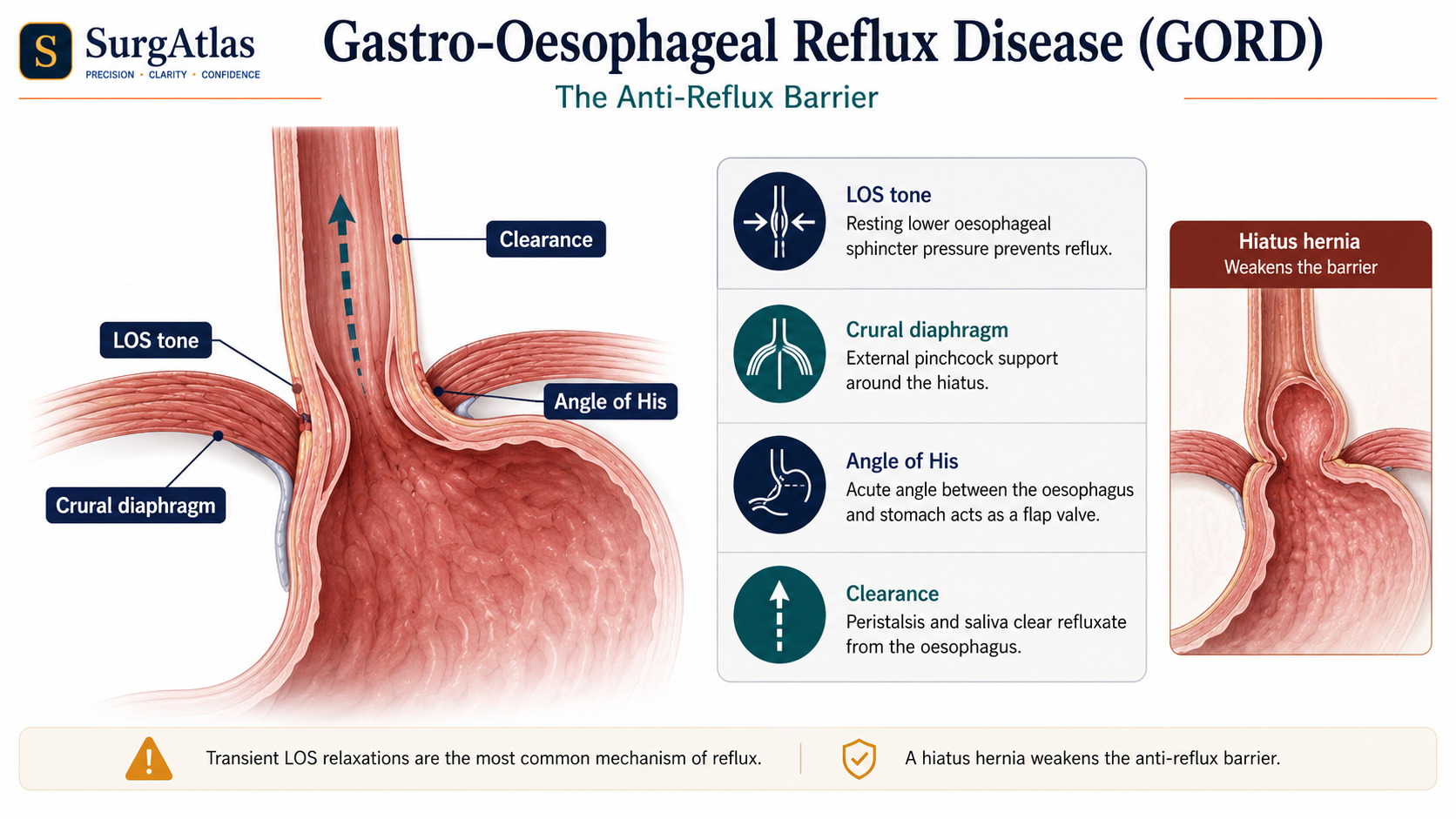
Transient LOS relaxations are a major reflux mechanism.
- 02
A hiatus hernia weakens the crural and geometric anti-reflux barrier.
- 03
Alarm symptoms require investigation rather than empirical escalation.
- 04
Endoscopy assesses structure; reflux monitoring measures reflux; manometry measures motor function.
- 05
Anti-reflux surgery requires objective disease and appropriate physiology.
1. Build the anti-reflux barrier
- Lower oesophageal sphincter tone limits retrograde flow.
- The crural diaphragm acts as an external sphincter during inspiration and strain.
- The intra-abdominal oesophagus and angle of His add a flap-valve effect.
- Peristalsis and saliva clear refluxate; dysmotility increases exposure time.
- Large meals, delayed emptying and raised intra-abdominal pressure increase reflux burden.
2. Typical symptoms versus alarm features
| Pattern | Interpretation |
|---|---|
| Heartburn and effortless regurgitation | Typical reflux pattern; may justify an initial therapeutic trial if no alarm features. |
| Dysphagia, odynophagia, bleeding or anaemia | Investigate for stricture, ulcer, Barrett mucosa or malignancy. |
| Chronic cough/hoarseness/wheeze | Often multifactorial; do not assume reflux when treatment fails. |
| Central chest pain | Exclude cardiac and other cardiopulmonary causes first. |
3. Match test to question
| Question | Test |
|---|---|
| Uncomplicated typical symptoms | Empirical full-dose PPI for 4–8 weeks. |
| Mucosal complication or alarm feature | Upper-GI endoscopy with biopsy as indicated. |
| Uncertain diagnosis with normal endoscopy | Ambulatory reflux monitoring, usually off acid suppression. |
| Persistent symptoms in proven GORD | Specialist pH-impedance monitoring. |
| Dysphagia or pre-operative assessment | High-resolution manometry. |
4. Initial management
- Support healthy weight, smoking cessation and avoidance of meals close to sleep.
- Use a full-dose PPI for 4 or 8 weeks and check timing/adherence before declaring failure.
- After control, use the lowest effective strategy unless severe oesophagitis or another complication requires maintenance.
- Review the diagnosis and objective evidence rather than escalating acid suppression indefinitely.
5. Complicated reflux
- Severe oesophagitis: longer treatment and maintenance PPI may be required.
- Peptic stricture: biopsy/assessment, endoscopic dilatation and long-term acid control.
- Barrett oesophagus: separate surveillance/dysplasia pathway.
- Bleeding or ulcer: follow the upper-GI bleeding pathway and exclude malignancy.
6. Anti-reflux surgery is not a diagnostic trial
Surgery should treat objectively demonstrated reflux in a patient whose symptoms and goals match what fundoplication can improve. Pre-operative assessment commonly includes endoscopy, manometry and reflux monitoring.
| Potential benefit | Important trade-off |
|---|---|
| Improved reflux/regurgitation | Early or persistent dysphagia. |
| Reduced medication dependence | Gas-bloat, inability to belch/vomit or altered satiety. |
| Repair of associated hiatus defect | Wrap migration, recurrent hernia or recurrent reflux. |
Active recall
Close the notes and answer these
Try each question from memory before revealing the answer. These public prompts are a small preview of the integrated retrieval system inside SurgAtlas.
01Can GORD exist with a normal endoscopy?
Yes. Endoscopy-negative reflux disease is recognised.
02What are the major components of the anti-reflux barrier?
LOS tone, crural diaphragm, intra-abdominal oesophagus/angle of His, oesophageal clearance and gastric pressure/emptying factors.
03What does manometry assess?
Oesophageal motor function; it does not diagnose GORD by itself.
04When should anti-reflux surgery be considered?
In selected patients with objectively demonstrated reflux, appropriate physiology and symptoms/goals likely to benefit.
05Should fundoplication be offered solely to prevent Barrett cancer?
No.
Sources & editorial basis
References & editorial basis
- SurgAtlas production source. General Surgery — Gastro-Oesophageal Reflux Disease (GORD). Public lesson curated from the corresponding production chapter.
- NICE CG184. Gastro-oesophageal reflux disease and dyspepsia in adults: investigation and management.
This lesson is derived from the corresponding SurgAtlas production teaching material. Where the source makes current management or guideline claims, the public lesson uses the cited contemporary guidance. It is written for education and examination preparation, not as patient-specific clinical advice.
Editorial details
Medical Doctor (MD) · MRCS Part A · Physician · Surgical Educator
SurgAtlas is an educational resource. For patient care, verify current national guidance, local antimicrobial and transfusion policies, specialty pathways and individual patient factors.
Continue in SurgAtlas
Turn reading into retrieval.
Use the full learning workspace for chapter progress, integrated questions, review scheduling and exam-focused study tools. Free accounts do not include recurring AI usage.