High-yield map
Key points before the detail
- 01
Difficulty initiating a swallow suggests oropharyngeal disease.
- 02
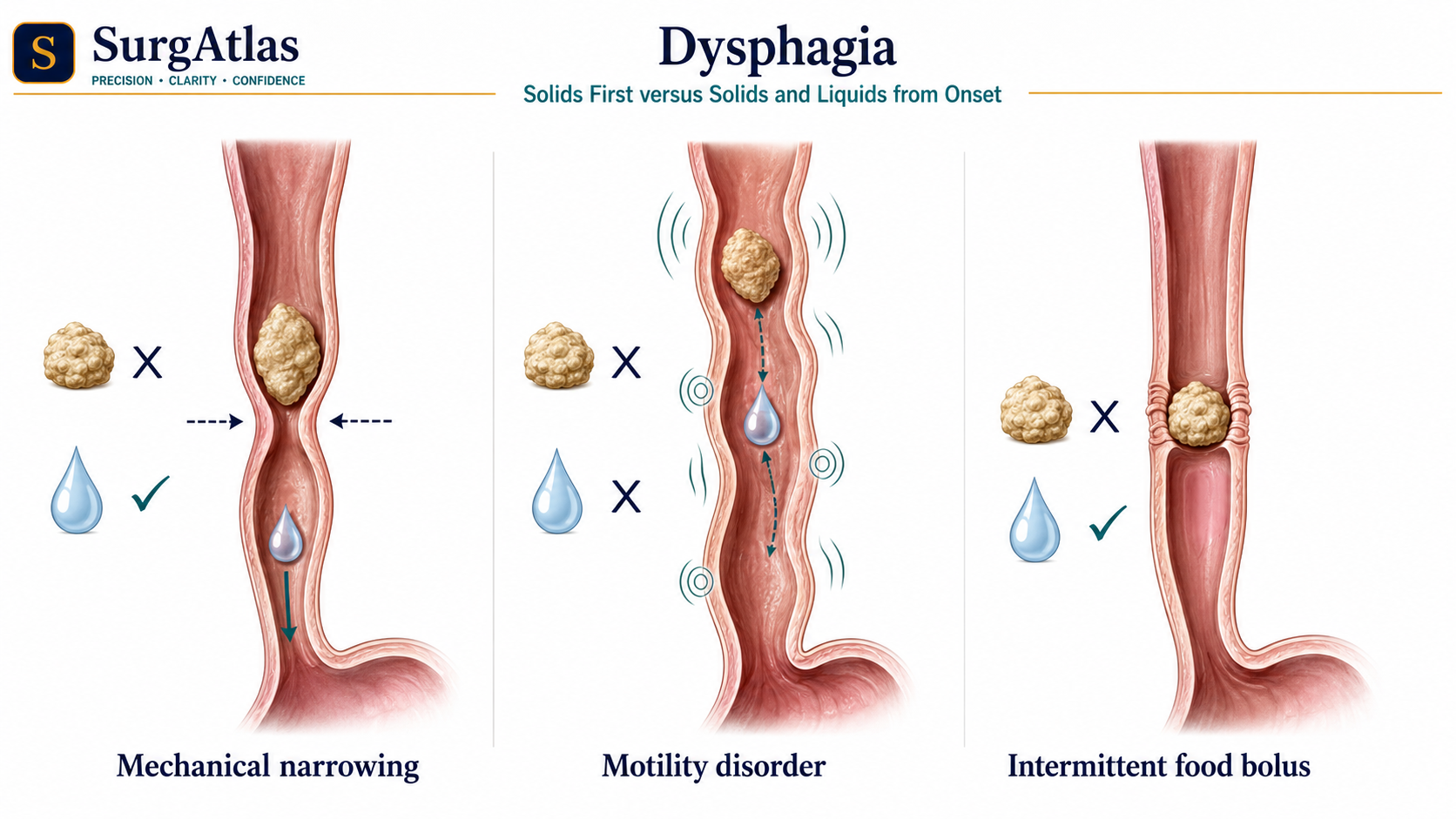
Solids first suggests mechanical narrowing; solids and liquids from the start suggests motility disease.
- 03
Aspiration-prone dysphagia requires safe-swallow management before oral intake.
- 04
Oesophageal dysphagia with cancer concern needs OGD and biopsy.
- 05
Manometry defines physiology after structural disease has been assessed.
1. Localise before ordering tests
| Question | Interpretation |
|---|---|
| Difficulty initiating a swallow with coughing, choking or wet voice? | Oropharyngeal dysfunction; aspiration risk comes first. |
| Food passes the throat then sticks behind the sternum? | Oesophageal dysphagia; perceived level can be misleading. |
2. Solids versus liquids
| Pattern | Likely mechanism | Examples |
|---|---|---|
| Solids first, later liquids | Mechanical narrowing | Cancer, peptic stricture, Schatzki ring, eosinophilic oesophagitis. |
| Solids and liquids from onset | Motility/outflow disorder | Achalasia or another major motility disorder. |
| Intermittent solids with bolus episodes | Ring/web or eosinophilic oesophagitis | Atopy and previous food impaction support EoE. |
3. Immediate red flags
- Unable to swallow saliva or complete food-bolus obstruction: nil by mouth, assess airway and arrange urgent endoscopic/ENT review.
- Coughing, choking, recurrent chest infection or desaturation with meals: stop unsafe oral intake and obtain urgent swallow assessment.
- Severe chest or neck pain after vomiting or instrumentation: consider oesophageal perforation.
- Acute neurological deficit with dysphagia: follow the acute stroke pathway.
4. Choose the test that answers the question
| Clinical problem | Best next test |
|---|---|
| Oropharyngeal dysphagia/aspiration | Speech and language assessment, then videofluoroscopy or FEES when indicated. |
| Oesophageal dysphagia or cancer concern | Upper-GI endoscopy with biopsy. |
| Very tight/proximal lesion or pharyngeal pouch | Barium swallow before or alongside endoscopy. |
| Persistent dysphagia with normal structural assessment | High-resolution oesophageal manometry. |
| Suspected achalasia | OGD to exclude pseudoachalasia plus manometry; timed barium can quantify emptying. |
5. Aspiration and nutrition are part of treatment
- Do not prescribe oral intake until swallowing safety is known when aspiration is suspected.
- Correct dehydration and involve dietetics early; document weight loss and intake.
- Choose enteral access according to level and expected duration of obstruction.
- Prevent refeeding syndrome in severely malnourished patients using current nutrition protocols.
6. Definitive management follows mechanism
- Cancer: stage and treat through the oesophago-gastric MDT.
- Benign stricture: biopsy to exclude malignancy, control acid and dilate carefully.
- Achalasia: specialist choice among pneumatic dilatation, Heller myotomy and POEM.
- Neurological dysphagia: rehabilitation, texture/fluid modification, oral care and enteral feeding when needed.
Active recall
Close the notes and answer these
Try each question from memory before revealing the answer. These public prompts are a small preview of the integrated retrieval system inside SurgAtlas.
01What symptom pattern suggests a mechanical oesophageal obstruction?
Dysphagia to solids first, progressing to liquids as narrowing worsens.
02What pattern suggests a motility disorder?
Dysphagia to solids and liquids from the onset.
03What is the first priority in aspiration-prone oropharyngeal dysphagia?
Airway and safe-swallow management, including stopping unsafe oral intake.
04What is the core test for oesophageal dysphagia with cancer concern?
Upper-GI endoscopy with biopsy.
05When is high-resolution manometry used?
After structural assessment when a motility disorder such as achalasia remains suspected.
Sources & editorial basis
References & editorial basis
- SurgAtlas production source. General Surgery — Dysphagia. Public lesson curated from the corresponding production chapter.
- NICE NG12. Suspected cancer: recognition and referral — dysphagia is a key upper-GI cancer pathway symptom.
This lesson is derived from the corresponding SurgAtlas production teaching material. Where the source makes current management or guideline claims, the public lesson uses the cited contemporary guidance. It is written for education and examination preparation, not as patient-specific clinical advice.
Editorial details
Medical Doctor (MD) · MRCS Part A · Physician · Surgical Educator
SurgAtlas is an educational resource. For patient care, verify current national guidance, local antimicrobial and transfusion policies, specialty pathways and individual patient factors.
Continue in SurgAtlas
Turn reading into retrieval.
Use the full learning workspace for chapter progress, integrated questions, review scheduling and exam-focused study tools. Free accounts do not include recurring AI usage.