
High-yield map
Key points before the detail
- 01
Assess airway and haemodynamics before trying to identify the precise bleeding lesion.
- 02
NICE recommends the Glasgow-Blatchford score at first assessment and considers early discharge at a score of 0.
- 03
Unstable severe UGIB requires endoscopy immediately after adequate resuscitation; other admitted patients should have endoscopy within 24 hours under NICE CG141.
- 04
Adrenaline must not be used alone for endoscopic treatment of non-variceal bleeding.
- 05
Suspected variceal bleeding requires vasoactive therapy and prophylactic antibiotics from presentation, followed by urgent endoscopic control.
1. Recognise the syndrome and the airway risk
Upper GI bleeding may present with fresh haematemesis, coffee-ground vomiting, melaena or, in rapid major bleeding, haematochezia. The apparent volume of vomited blood does not reliably measure total blood loss. Tachycardia, hypotension, poor peripheral perfusion, altered mental state and reduced urine output matter more than visual estimation.
Airway protection is selective. Uncontrolled haematemesis, severe encephalopathy, agitation or inability to protect the airway should prompt early anaesthetic involvement. Routine prophylactic intubation is not required for every patient.
2. Risk-stratify before endoscopy
The Glasgow-Blatchford score uses urea, haemoglobin, systolic blood pressure, pulse, melaena, syncope, hepatic disease and cardiac failure. NICE CG141 recommends using it at first assessment and considering early discharge when the score is 0. Contemporary ESGE guidance identifies 0–1 as a very-low-risk range that may be suitable for outpatient management when clinical and social circumstances are appropriate.
The full Rockall score is calculated after endoscopy and incorporates age, shock, comorbidity, diagnosis and endoscopic stigmata. Use scores to support—not replace—clinical judgement. Haemodynamic instability and active bleeding override numerical thresholds.
3. Initial resuscitation
- ABCDE, immediate senior review, monitoring and large-bore IV access.
- Send FBC, renal and liver tests, coagulation, fibrinogen, lactate and crossmatch according to severity/local protocol.
- Use judicious crystalloid while blood is prepared; activate the local major-haemorrhage protocol for ongoing severe bleeding.
- During active shock, transfuse according to physiology rather than waiting for a later haemoglobin threshold.
- For stable adults without major haemorrhage or acute coronary syndrome, NICE NG24 supports a restrictive red-cell threshold around 70 g/L with a post-transfusion target of 70–90 g/L; in acute coronary syndrome it advises considering 80 g/L with a target of 80–100 g/L.
- Review anticoagulants and antiplatelets urgently; reversal and continuation decisions depend on the drug, indication, bleeding severity and specialist/local protocols.
4. Timing of endoscopy
The 2026 ESGE peptic-ulcer guideline emphasises that routine emergent (≤6 h) or urgent (≤12 h) endoscopy is not beneficial for non-variceal peptic-ulcer bleeding unless haemodynamic instability persists despite adequate resuscitation. This is compatible with prioritising resuscitation before endoscopy.
| Situation | Timing principle |
|---|---|
| Unstable severe UGIB | NICE: endoscopy immediately after adequate resuscitation. |
| Other admitted UGIB | NICE: endoscopy within 24 hours of admission. |
| Suspected variceal haemorrhage | ESGE: endoscopic evaluation within 12 hours after haemodynamic resuscitation. |
5. Peptic-ulcer and other non-variceal bleeding
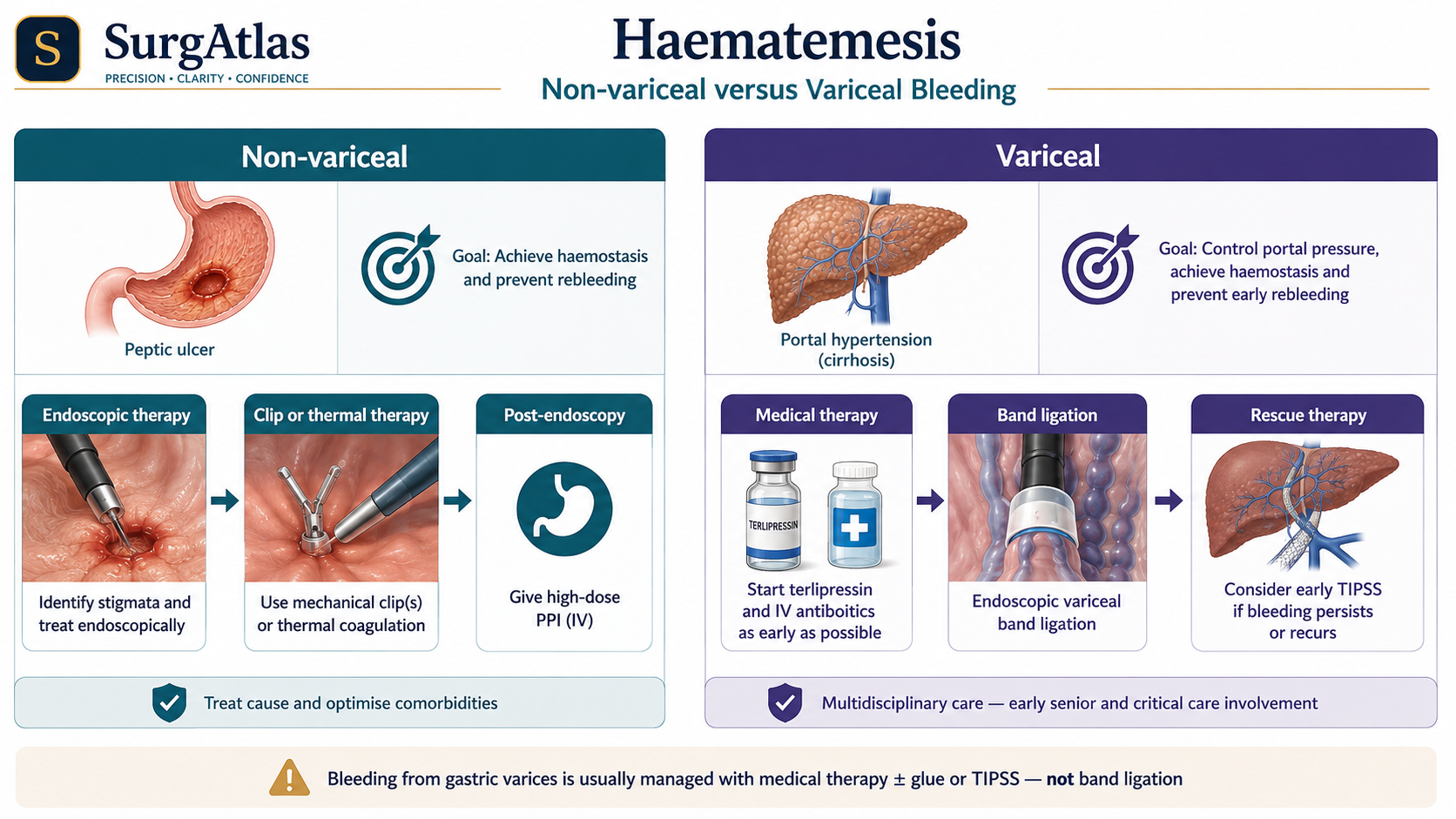
- Endoscopically treat actively bleeding ulcers and non-bleeding visible vessels using an effective mechanical, thermal or guideline-supported combination technique.
- Adrenaline/epinephrine injection must not be used as monotherapy.
- Under NICE CG141, do not routinely give acid suppression before endoscopy for suspected non-variceal UGIB. ESGE 2026 allows high-dose IV PPI to be considered before endoscopy, but it must not delay endoscopy; follow the local UK protocol.
- After successful endoscopic haemostasis of high-risk peptic-ulcer stigmata, use high-dose PPI therapy according to the local evidence-based regimen.
- If clinically significant rebleeding occurs, repeat endoscopic treatment is the usual next step; if endoscopic control fails, transcatheter angiographic embolisation is preferred where available, with surgery when embolisation is unavailable or unsuccessful.
6. Suspected variceal bleeding
- Start a guideline-supported vasoactive agent at presentation (for example terlipressin according to UK/local protocol) rather than waiting for endoscopic confirmation.
- Give prophylactic antibiotics from presentation; regimen should follow local resistance, allergy and liver-disease policy.
- Perform endoscopy within 12 hours once haemodynamically resuscitated.
- Use band ligation for oesophageal varices; gastric-variceal management differs and may require tissue adhesive or specialist endovascular approaches.
- High-risk patients may be considered for pre-emptive TIPS within 72 hours, preferably within 24 hours, according to specialist criteria.
- Persistent uncontrolled oesophageal-variceal bleeding requires rescue therapy and urgent TIPS planning; a covered oesophageal stent may be used as a bridge where available, while balloon tamponade is a temporary alternative in expert care.
7. Mallory–Weiss versus Boerhaave syndrome
| Feature | Mallory–Weiss tear | Boerhaave syndrome |
|---|---|---|
| Pathology | Mucosal tear causing bleeding | Transmural oesophageal perforation |
| Typical context | Haematemesis after vomiting/retching; often self-limiting | Forceful vomiting followed by severe chest, epigastric or back pain; presentation may be atypical |
| Danger signs | Ongoing haemorrhage | Dyspnoea, sepsis, pleural signs, pneumomediastinum or shock |
| Key investigation | Upper endoscopy if ongoing/significant bleeding | Urgent contrast-enhanced CT with CT oesophagography in the SurgAtlas source pathway |
8. MRCS answer structure
A safe viva answer is chronological: “I would assess airway and circulation, obtain large-bore IV access and bloods/crossmatch, resuscitate according to physiology, calculate the Glasgow-Blatchford score once immediate threats are addressed, review antithrombotic therapy, and arrange appropriately timed endoscopy. If variceal bleeding is suspected I would start vasoactive therapy and prophylactic antibiotics immediately. Definitive escalation depends on the endoscopic source and whether haemostasis is achieved.”
Active recall
Close the notes and answer these
Try each question from memory before revealing the answer. These public prompts are a small preview of the integrated retrieval system inside SurgAtlas.
01Which score is used before endoscopy in upper GI bleeding?
The Glasgow-Blatchford score.
02What does NICE advise for endoscopy timing in unstable severe UGIB?
Endoscopy immediately after adequate resuscitation.
03Can adrenaline be used alone for non-variceal endoscopic haemostasis?
No. NICE and ESGE guidance do not support epinephrine/adrenaline as monotherapy.
04What two treatments should begin at presentation when variceal bleeding is suspected?
A vasoactive agent and prophylactic antibiotics, alongside haemodynamic resuscitation.
05What is the escalation after failed repeat endoscopic control of peptic-ulcer bleeding?
Transcatheter angiographic embolisation where available; surgery if embolisation is unavailable or unsuccessful.
Sources & editorial basis
References & editorial basis
- SurgAtlas production source. Emergency Presentations — Upper GI Haemorrhage, including current guideline corrections and MRCS framework.
- NICE CG141. Acute upper gastrointestinal bleeding in over 16s: management. Source ↗
- NICE NG24. Blood transfusion — red blood cell thresholds and targets. Source ↗
- ESGE 2026. Endoscopic diagnosis and management of peptic ulcer bleeding: guideline update 2026. Source ↗
- ESGE. Endoscopic diagnosis and management of esophagogastric variceal hemorrhage. Source ↗
This lesson is derived from the corresponding SurgAtlas production teaching material. Where the source makes current management or guideline claims, the public lesson uses the cited contemporary guidance. It is written for education and examination preparation, not as patient-specific clinical advice.
Editorial details
Medical Doctor (MD) · MRCS Part A · Physician · Surgical Educator
SurgAtlas is an educational resource. For patient care, verify current national guidance, local antimicrobial and transfusion policies, specialty pathways and individual patient factors.
Continue in SurgAtlas
Turn reading into retrieval.
Use the full learning workspace for chapter progress, integrated questions, review scheduling and exam-focused study tools. Free accounts do not include recurring AI usage.