
High-yield map
Key points before the detail
- 01
Use NEWS2 plus clinical judgement and trajectory in adult acute-hospital sepsis assessment in England.
- 02
A low qSOFA or normal temperature does not exclude sepsis.
- 03
NICE NG253 uses 250 mL isotonic crystalloid boluses with reassessment for adult sepsis fluid resuscitation, not an automatic large fixed bolus.
- 04
Drainage, debridement, decompression, removal of an infected device or repair of a leak/perforation may be as important as antimicrobial therapy.
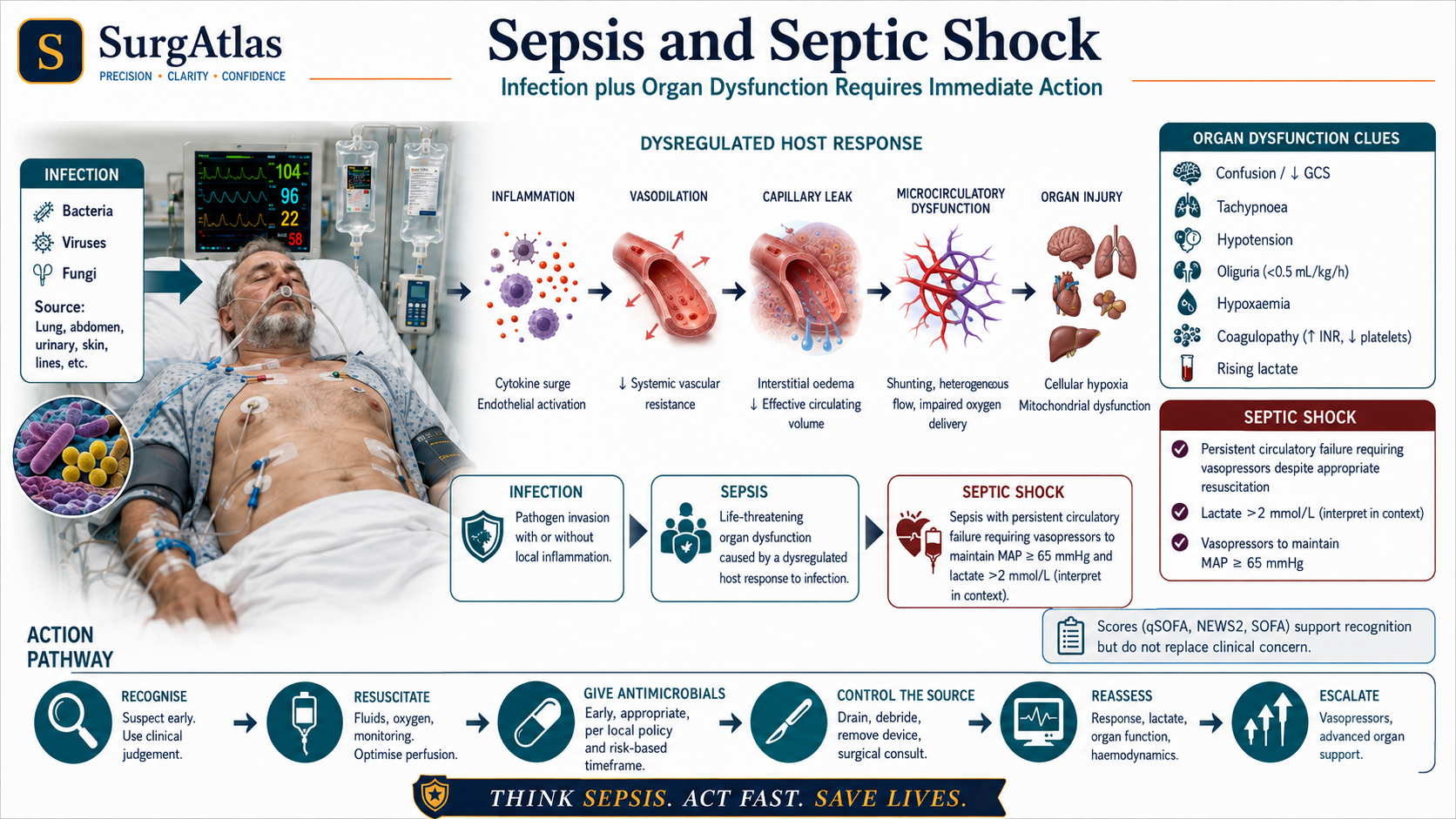
Definitions that keep the answer precise
| Term | Meaning |
|---|---|
| Infection | Microbial invasion or harmful proliferation at a body site; infection does not automatically mean sepsis. |
| Sepsis | Life-threatening organ dysfunction caused by a dysregulated host response to infection. |
| Septic shock | A severe subset of sepsis with persistent circulatory/metabolic abnormality requiring vasopressors to maintain MAP at least 65 mmHg and lactate above 2 mmol/L despite appropriate volume assessment/resuscitation. |
Recognition: use the patient, NEWS2 and trajectory
NICE NG253 applies to people aged 16 or over who are not and have not recently been pregnant. In acute hospitals it combines clinical assessment with NEWS2. A single score must be interpreted against baseline physiology, comorbidity, evidence of hypoperfusion and staff/family concern. Fever is neither required nor sufficient.
- Look for new confusion, tachypnoea, increasing oxygen need, hypotension or poor perfusion, oliguria/AKI, coagulopathy and unexpected postoperative deterioration.
- A moderate-risk patient with evidence of hypoperfusion such as lactate above 2 mmol/L or AKI should be managed as high risk under NG253.
- qSOFA can describe risk in some contexts but should not replace the NICE acute-hospital pathway.
Current NICE acute-hospital priorities
| Problem | Current principle |
|---|---|
| High risk | Urgent senior assessment and investigations; give broad-spectrum IV antibiotics within 1 hour of the first NEWS2 assessment for the episode when indicated. |
| Moderate risk | Prompt clinician review; NICE allows diagnostic clarification before broad-spectrum antibiotics in selected patients, but once the decision to treat is made administration should not be delayed. |
| Fluid resuscitation | If needed, use an isotonic electrolyte crystalloid; give 250 mL over about 10–15 minutes, reassess, and repeat only if needed up to 1,000 mL before senior advice if response remains inadequate. |
| Escalation | Failure to respond to intervention requires senior decision-maker attendance and critical-care discussion/escalation. |
The surgical difference: source control
Pus, devitalised tissue, an obstructed infected system, an infected device, perforation or anastomotic leak can continue driving sepsis despite appropriate antimicrobial therapy. Ask “what is the anatomical source, and what physically removes or controls it?” during the initial assessment.
| Source problem | Examples of control |
|---|---|
| Collection | Percutaneous or operative drainage where appropriate |
| Devitalised/infected tissue | Debridement |
| Obstructed infected system | Decompression or drainage |
| Infected foreign material/device | Removal or exchange when clinically appropriate |
| Perforation/leak | Operative, endoscopic or radiological control according to anatomy and physiology |
Antimicrobial stewardship still matters
Empirical antimicrobial choice, dose, renal adjustment and resistant-organism coverage depend on likely source, allergy history, previous microbiology, local resistance patterns and the current NHS trust formulary. Samples should be obtained before antimicrobials when this does not delay urgent treatment. Once microbiology or a source is known, therapy should be reviewed and narrowed when appropriate.
Active recall
Close the notes and answer these
Try each question from memory before revealing the answer. These public prompts are a small preview of the integrated retrieval system inside SurgAtlas.
01What risk tool does current NICE use for adult acute-hospital suspected sepsis in England?
NEWS2 interpreted with clinical judgement, baseline physiology, trajectory and evidence of hypoperfusion.
02What initial fluid-bolus volume does NICE NG253 recommend when an adult with suspected sepsis needs IV fluid resuscitation?
250 mL isotonic electrolyte crystalloid, ideally over about 10–15 minutes, followed by reassessment.
03Why are antibiotics alone sometimes insufficient in surgical sepsis?
An anatomical focus such as pus, devitalised tissue, obstruction, an infected device, perforation or leak may require drainage, debridement, decompression, removal or repair.
Sources & editorial basis
References & editorial basis
- SurgAtlas production chapter — Sepsis and Source Control. Primary SurgAtlas source. Guideline-dependent statements in this public lesson were separately checked against the current authoritative sources listed below.
- NICE NG253 — Suspected sepsis in people aged 16 or over. Published 19 November 2025; current adult recognition, NEWS2-based risk assessment, antibiotics, fluids, escalation and source-control recommendations. Source ↗
This lesson is derived from the corresponding SurgAtlas production teaching material. Where the source makes current management or guideline claims, the public lesson uses the cited contemporary guidance. It is written for education and examination preparation, not as patient-specific clinical advice.
Editorial details
Medical Doctor (MD) · MRCS Part A · Physician · Surgical Educator
SurgAtlas is an educational resource. For patient care, verify current national guidance, local antimicrobial and transfusion policies, specialty pathways and individual patient factors.
Continue in SurgAtlas
Turn reading into retrieval.
Use the full learning workspace for chapter progress, integrated questions, review scheduling and exam-focused study tools. Free accounts do not include recurring AI usage.